03 · Design Ethnography · 2026
Muted teamwork: belonging in competitive play
A four-week virtual ethnography of the social friction new players encounter when entering Counter-Strike 2 team play.
OwnershipIndividual ethnographic project
I planned the fieldwork, conducted the observations, collected diary material, developed the codebook, and wrote the pictorial paper.
Research question
What social challenges do new players face when they try to integrate into an established online competitive-game community?
Approach
From question to evidence.
- 01
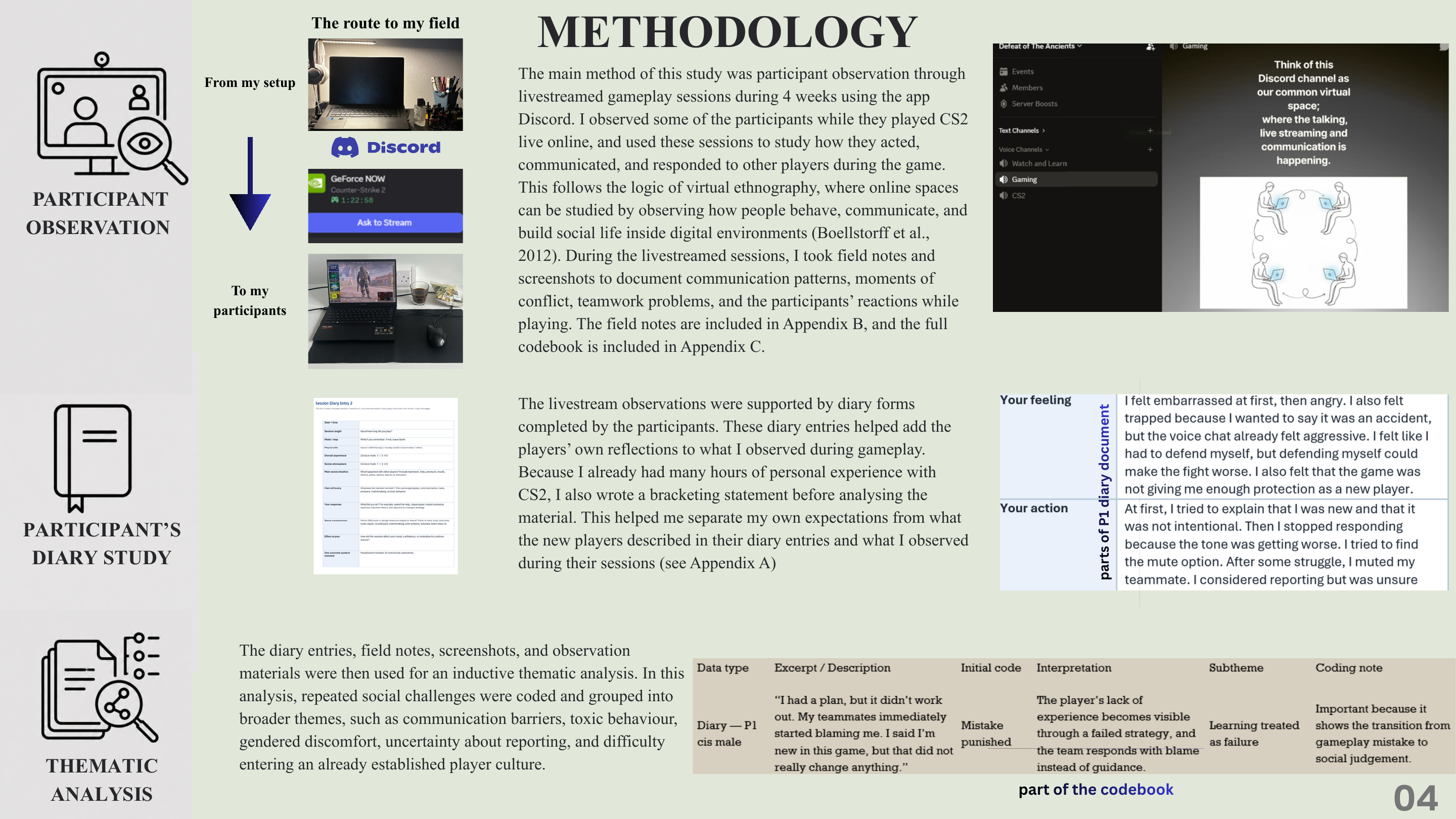
Observed livestreamed gameplay over four weeks through Discord, recording field notes and screenshots while following three new players.
- 02
Used participant diaries to capture how incidents were understood after play, then compared those reflections with moments observed in-session.
- 03
Applied inductive thematic analysis to diary entries, field notes, screenshots, and observations. I also documented bracketing because I entered the project with more than 4,000 hours of personal CS2 experience.
What the work found
Six connected themes emerged: assumed expertise under pressure, voice chat as both help and harm, escalation from small mistakes, weak reporting, the dilemma of anonymity, and a need for different forms of moderation. The analysis reframed onboarding as social survival as well as mechanical learning.
Limitations & next step
Muting can offer immediate protection, but it also removes information required for teamwork. The paper therefore points toward smaller, moderated, beginner-friendly spaces. The study is deliberately narrow: three diary contributors within one game context, not a representative account of all players.
Evidence from the source work
Selected artifacts.
Methods & tools used here